Making Climate Sexy?
Author and strategist Sanjana Sekhar wants to shift climate messaging from guilt to pleasure and inspire a movement rooted in desire and justice

By Antonio Hernandez, Hip Hop Caucus
Talking about climate isn’t inherently sexy. The increase in record droughts, storms and forced migration is ubiquitous in social media and news – not to mention making great fodder for some of my more recent dystopian books and streaming binges. Los Angeles-based author and narrative strategist Sanjana Sekhar is trying to change that. After beginning her career in advertising and business strategy, Sanjana found herself frustrated that her skills were being used to drive profits and not to make the world a healthier place to live.
Two years ago, Sanjana decided to channel that frustration, along with her interests and studies in feminism, literature and sexual education, into her online platform GARMI. Inspired by writers like Audre Lorde and Adrienne Maree Brown, Sanjana has used GARMI to connect with her community in Los Angeles and beyond, while ‘learning out loud,’ about issues related to climate change and environmental justice. We spoke about GARMI, the connection between sexuality and sustainability and why she believes that “the planet is getting hotter, but so are we.”
This interview has been edited for length and clarity.
I think we first met when you came to Hip Hop Caucus events over at the L.A. office, but I’m sure you’ve been to loads of other events.. What kind of messaging or tactics have you seen that organizations have been using that you think worked or didn’t work?
I think what I’ve seen historically is that on the opposition side, fossil fuel industry people have billions of dollars that they pour into marketing to make petrochemical culture feel really sexy. Our response has always been to try to teach our way out of that, but in a way that feels oftentimes like “finger-waggy” or playing into the shame side of things like, oh, you should give up your “X,Y,Z” lifestyle if you care about the planet.
Whereas the fossil fuel angle is always like, “we’re going to upgrade your lifestyle, we’re going to make things better, faster, stronger, convenient, etc.,”and we fought back by saying you’re a bad person for wanting those things.
And I think that has never been successful because positioning something as sacrificial isn’t going to really attract more people into the space, especially if those people don’t feel connected to it already. I think what I love about Hip Hop Caucus and what I’m seeing more in certain ways of certain climate messaging now, is that we’re embracing this idea that sustainability is an upgrade to your life.
Positioning something as sacrificial isn’t going to really attract more people into the space, especially if those people don’t feel connected to it already.
We are starting to show people that we all win when we come together and protect people and the planet.And I think that message is only intensifying today, in the current political climate, where we’re seeing growing class consciousness and more people realizing that when we unite to fight top versus bottom, rather than left versus right, we can actually make all of our lives better.
And climate is part of that, rather than something standalone or something that is just reserved for like hippies or ‘crunchy’ people or people who like to do outdoor activities. This is the planet we all live on. And so I’m trying to see more of that messaging change, which is really exciting.
You’ve mentioned, making climate messaging sexy and a background in reproductive and sexual health. How have you merged those two?
At the end of the day, whether we’re talking about sexual education around consent and around how people move in intimate partner relationships, whether we’re talking about that or we’re talking about climate, both those things are about two things: one, what our relationship to ourselves and somebody or something else is, and whether that’s a healthy relationship or a toxic relationship, whether it’s extractive or whether it’s reciprocal.
We hear people talk about how the same way that patriarchy plunders women’s bodies, capitalism plunders the Earth. So I think there’s a connection there.
And then the second thing is it’s a question of changing what turns us on, I think in a lot of ways. I think people when the consent conversation was first coming on the scene and there was a lot of conversation around campus sexual assault and things like that, which I was very involved in way back in college, a lot of people’s pushback would be, it’s not sexy to be like, “can I kiss you?” Or it’s not sexy to ask for consent. And so to me, it became another kind of messaging strategy question where it’s like, why would you want to engage in any kind of interaction with somebody that’s not really excited to be there?
And I feel like it’s a similar thing with climate justice, where it’s like, why would we want to have relationships to each other and to the earth that feel bad. You want things to feel productive, you want things to feel generative, you want things to feel really consensual. And in so many ways, corporations don’t ask consent in communities before they put data centers, power plants, pipelines, you name it.
You want things to feel productive, you want things to feel generative, you want things to feel really consensual. And in so many ways, corporations don’t ask consent in communities before they put in data centers, power plants, pipelines, you name it.
Can you talk a bit about how the song “HEATED” with Anusha came together? Did you get any feedback from folks who were nervous about the themes of relationships and sexuality?
One thing I would love to bring up first to set the scene is have you ever read or heard of Audre Lorde’s “Uses of the Erotic?” I read it 12 years ago now for a class, and it just changed my entire life. And I feel like all of the work that I’ve done since then, is all still predicated on that one essay, because essentially what Audre Lorde talks about in that essay is that the idea of eroticism has been bastardized to be just like pornographic. And she’s like, that’s not what the erotic is.
The erotic, when you really look at its root meaning, and when you look at the way that it should be applied to society really means any time you’re doing something that is so spiritually aligned that it transcends language. So it could be dancing, it could be sexual activity, but it could be like conversation with a friend. It could be eating really good food. It could be being out in the community. It could be worship. All of these things are things that connect us to something that is much higher than us and that reminds us of the web of life that we are all involved in. There is a very specific and very cunning purpose to making the erotic something taboo to talk about because it hides our power from us.
And we don’t realize that when we’re tapped into what feels pleasurable, well, that’s when we’re tapped into the profoundness of life. And that’s what we’re fighting for when it comes to climate, right? It’s like we respect life so much that we’re fighting for it. We respect the life of ourselves and our communities, but also of the rivers and of other animals and this planet as a whole.
And so I think that has been so foundational to me, and it’s kind of one of the first things that helped me connect those dots where I was like, oh, this is about something. This is a crisis of spirit and not a crisis of carbon, which I think is really important to remember. And her words kind of help heal that crisis, I think.
When it comes to this song, I had been thinking for a long time about how often I’ll be listening to some music and it’s on repeat already in my head. And then two weeks later, I’ll pay attention to the words. And I’m like, this is kind of problematic, you know? (Laughs) I feel like by then it’s too late because I already like the songs, I’m already listening to them. I was like, why did it never happen the other way around? There are climate songs, but they’re not usually in the genre that I tend to gravitate towards. So I think that always disappoints me because I want there to be a climate song that I’m like, oh my God, this is fire, I want to put this on all the time.
I want there to be a climate song that I’m like, oh my God, this is fire, I want to put this on all the time.
So I was thinking, is there a way that we could use allegory to write a song that is just so fun and good, and then people later on are like, wait a minute, was this about Big Oil?
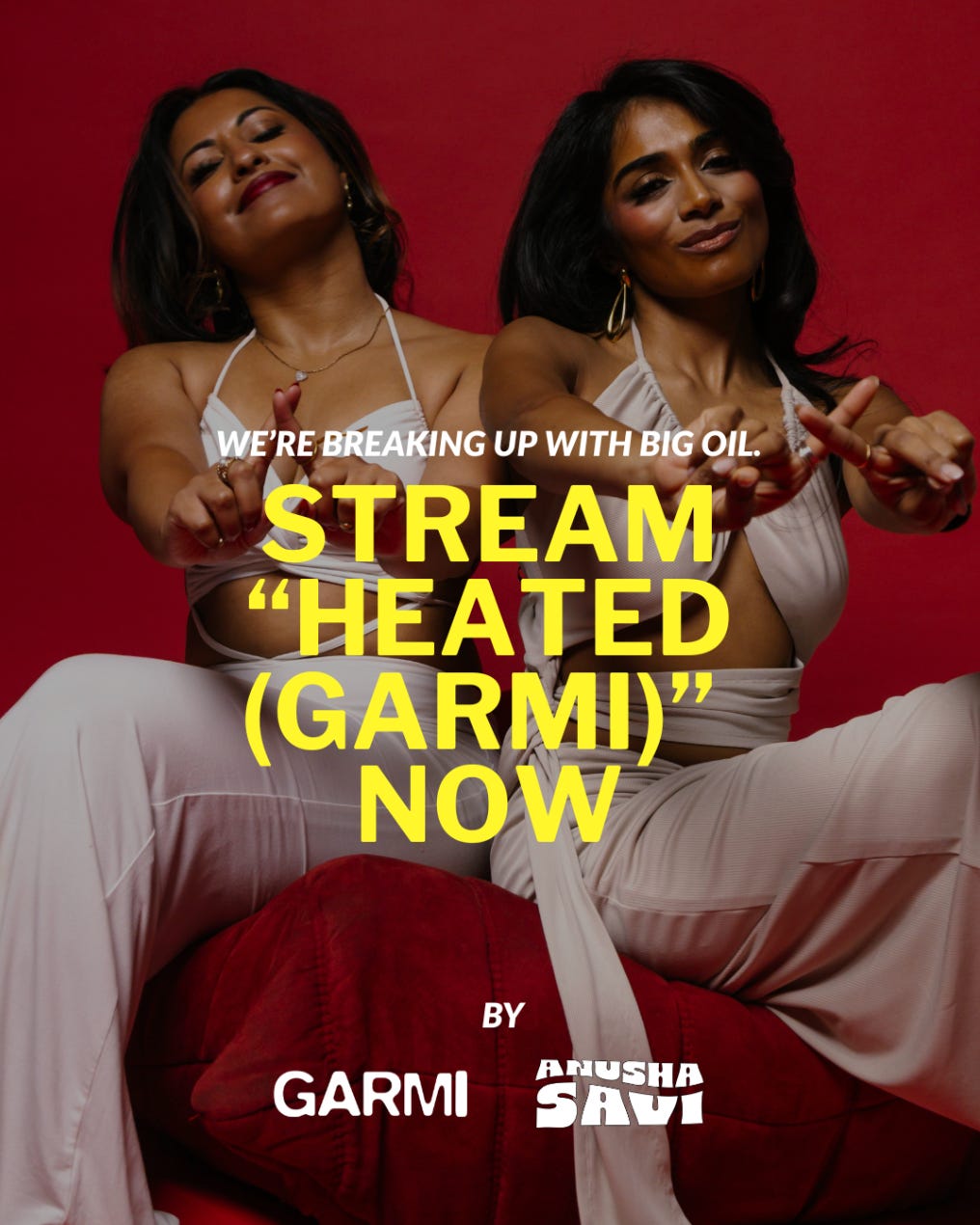
And so I partnered with a really good friend of mine who is an amazing artist songwriter. Her name is Anusha Savi, and we co-wrote, along with two other friends of ours, this song, “HEATED” under the GARMI banner and it’s basically a pop R&B breakup song all about breaking up with a toxic ex, which turns out to be Big Oil.
We had this whole campaign where I was pretending that I was in this really toxic relationship, and I hadn’t said who it was [with]. I was just on the internet, posting video clips of me and Anusha talking about how I’m in this terrible relationship. It’s so toxic. This guy’s telling me that there’s no future without him, and he’s always reminding me of everything that he’s done for me and making me feel like I can’t survive without him. I feel like even though I’ve gotten so much out of this [relationship], I don’t think this is good for me moving forward. And so I was on the internet saying this for like three weeks, without saying who the toxic person was.
And then we went out in the street and I said, the same story told everybody like, I’m in this toxic relationship. We played them the song and they were like, “oh man, you should break up with him, he sounds terrible. I’ve been in a toxic relationship before and it’s hard to leave because there is so much good, you’ve got to do it because this person’s not healthy for you.”
And then I was like, okay, do you want to know his name? I’m kind of scared to say his name, but I’ll try to be brave. So then I’ll be like, oh, his name is Shell, Exxon, Chevron, BP and everyone just like lost their shit. And then we launched into this whole thing about like, yeah, Big Oil has known that. They’ve been poisoning the earth since the 70s. They’ve been cheating us, they’ve been stealing from us. And all the while, they’ve been making us feel like there’s no future without them. Do you think it’s time for humanity to break up with Big Oil?

“They’ve been cheating us, they’ve been stealing from us. And all the while, they’ve been making us feel like there’s no future without them. Do you think it’s time for humanity to break up with Big Oil?”
We had two reactions. We had some people that were like, yeah, it’s time to break up with big oil. We have to move on to partnerships that are healthier for us, energy futures that are better for us. And then there are some people that were like, yeah, but like it’s a little bit more complicated than that because we have this energy demand, which was our chance to talk about the just transition.
And then we had my aunties and uncles who were calling me afterwards to say “I called your mom because I thought you were dating a really bad man.” And I was like, no, I’m so sorry, it was just a bit. It was like a really interesting storytelling experience because people can connect personally to what a toxic relationship is. And we’re really good at counseling our friends to break up with him. He’s bad for you, that’s not a healthy relationship. But when it comes to our collective toxic relationships, whether it’s with billionaires or with Big Oil or whatever it is, suddenly there’s this nuance that we’re like, oh, no, wait, wait a minute, we should stay.
I’ve been thinking about this a lot recently, too, because I started GARMI almost exactly two years ago, and it started off as just purely a Substack, where I was writing these nonfiction essays, twice a month that were basically digesting what’s going on in the world and trying to put historical context, and present day context around, all kinds of sociopolitical things that connect to climate. And “garmi” means heat in Hindi. And so the idea that I had was like in ayurveda, which is sort of my South Asian ancestral ecological knowledge, there’s an idea that heat can be transformative, right? Like heat can burn you and it can be really negative. But heat can also be incredibly positive. We say there’s a digestive fire that everybody has. And so for me, the question was like, all right, the planet is heating up, but how can we take that heat and use it for something transformative and make it something that helps us navigate the world the way forward, metaphorically speaking? And so GARMI kind of became my space to process these transformations and to learn out loud.
The planet is heating up, but how can we take that heat and use it for something transformative and make it something that helps us navigate the world the way forward.
And then along the way, I think it became a place where everybody who’s been subscribing and following has been kind of learning with me. So I think it’s kind of transformed into a space for political education and the highlighting of civic engagement. The last few months, I’ve been running an additional weekly newsletter that is responding to the news every week, and trying to highlight the ways in which, even though things are really scary, there’s a lot of people doing something about it.
And obviously right now they’re a very regressive government. And so I think the question is how do we have our own vision? Because I think unfortunately, oftentimes, the opposition is way more radically imaginative than we are. And I think that I’m really curious about how we can start to chart that future for ourselves and like, really get people on board.
Do you feel nervous or concerned at all about, speaking up, speaking out, and being visible in the way that you are?
Right now, I’m writing something about fascism that I am hoping to publish tomorrow. I was going to publish it like two, three weeks ago, and then the whole anti-fascism executive order came out and I was like, yikes. So I definitely do have fear around it. And I’ve had family members call me and say, “hey, super proud of you, but could you please stop talking about politics or anything? Talk about anything you want, but just don’t talk about politics, please.”
I fully get that fear, and I feel that fear. But the way that I look at it is like it’s scarier to not speak out than to speak out. Because what can happen if we stop speaking out is much more permanent and much more detrimental than what could happen if we do speak out, especially if we all continue putting pressure. If we decide that we’re scared now, that fast tracks fascist power.
And then I’m also watching who else is still speaking out. I’m not alone. Right? I think that’s the thing that gives me any sense of bravery or courage is that I look around and I’m like, oh my God, thousands of people are resisting thousands, like at all levels of society.
There’s like political people, visible people. Then there’s like everyday people, everybody. So I feel like I’m just part of that rather than like the, you know, I’m not like on my own, on it at all.
Follow Sanjana on Instagram @sanj___
Follow Anusha on Instagram: @anusha.savi
Follow GARMI on Instagram: @garmi.studio and on Substack: Sanjana